

Open or Closed
- Gustavo A Cano, CFA, FRM

- 11 minutes ago
- 2 min read
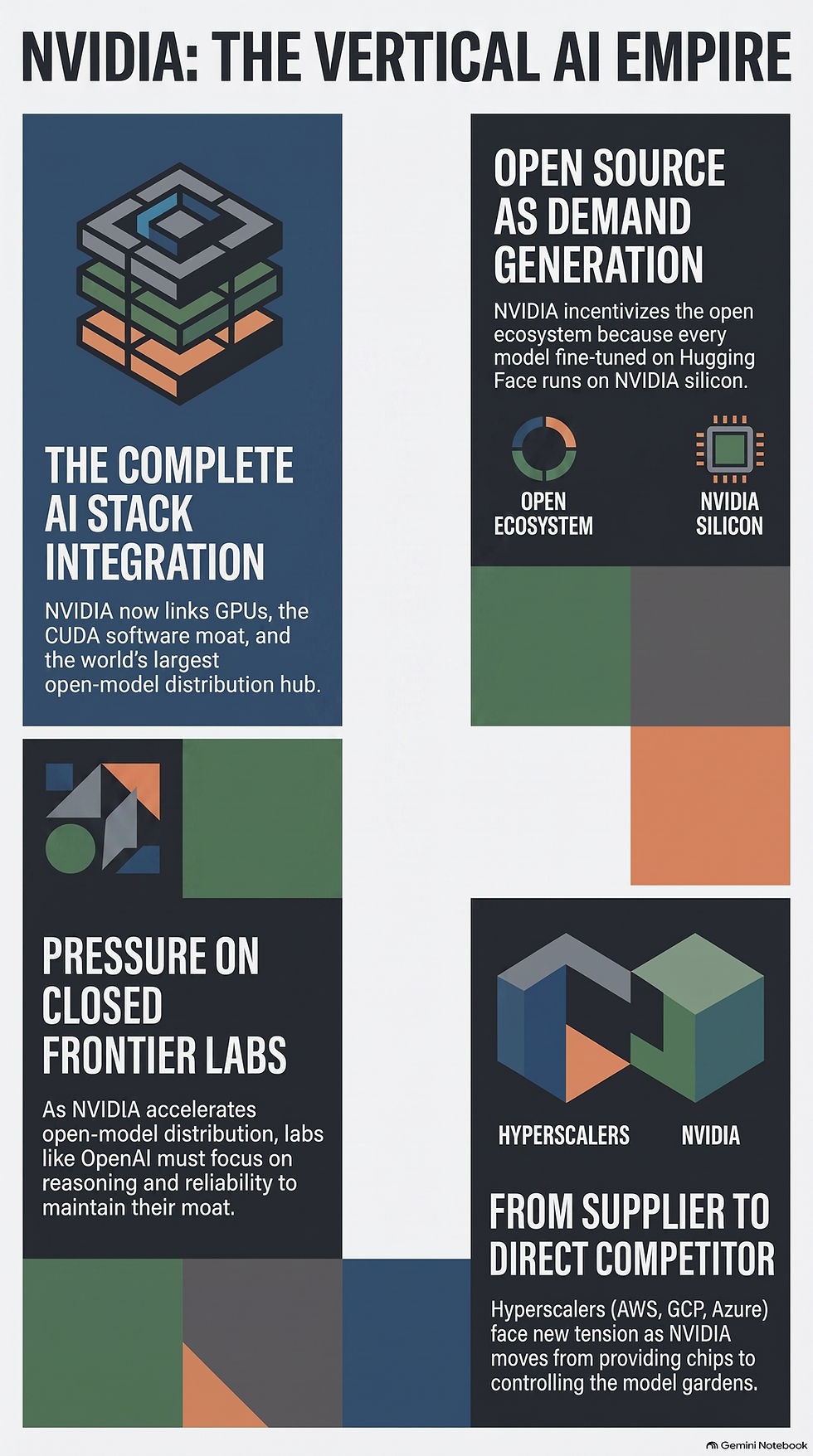
In the recent history of technology, we’ve had a couple of interesting debates: one is the PC vs Mac, and the other is Android vs iOS. In the AI empire, there’s now another similar choice between two options: open or closed models. To run parallels, open models would be similar in philosophy to PC or Android, while closed models will be similar to Mac/ iOS. Why is this relevante now? Because If reports of NVIDIA’s ~$13B acquisition of Hugging Face hold up, it isn’t just another tuck-in acquisition, it’s NVIDIA moving to own a full layer of the AI stack it doesn’t currently control: the distribution and community layer for open models. NVIDIA already has the compute (GPUs), the software moat (CUDA), and now, if the acquisition goes through, potentially the largest hub where open-weight models get published, discovered, and deployed. That’s a vertical integration play: chips to community to (eventually) applications. A few implications of this are: (1) For open models broadly: Expect NVIDIA to have real incentive to keep the open ecosystem thriving, every open model fine-tuned and deployed via Hugging Face likely runs on NVIDIA silicon. Open source isn’t charity here; it’s demand generation. (2) For OpenAI and Anthropic: This raises the strategic stakes of the closed vs. open debate. If NVIDIA is quietly subsidizing/accelerating the open ecosystem’s central distribution point, the frontier labs’ moat narrows to model quality + safety + enterprise trust, not access. Expect renewed emphasis on things open models can’t easily replicate: reliability at scale, agentic tooling, and long-context/reasoning performance. (3) For hyperscalers (AWS, Azure, GCP): Interesting tension. They’ve each tried to be “the” place enterprises go for models. NVIDIA controlling the biggest neutral-ish model hub could pressure their model-garden strategies, while also making NVIDIA a more direct competitor rather than “just” a supplier. The bigger picture: Infrastructure players increasingly want to own the full pipeline: chips, frameworks, distribution, and increasingly apps. Consolidation at the “picks and shovels” layer of AI is accelerating faster than most predicted a year ago.
Want to know more? You can register for free at Fund@mental.
#iamfundamental #soyfundamental #wealthmanagement #familyoffice #financialadvisor#financialplanning #policymistake #ratecut #stagflation


Comments